PwCEnterprise AI · Interaction design · Human–AI workflows
Designing trust into enterprise AI.
How I designed a verification workflow that makes machine-learning predictions understandable, reviewable and actionable.
- Organization
- PwC Germany, Munich
- Product
- Document Insights — AI extraction from business documents
- Period
- 2022 – 2024
- Role
- Senior UX Designer
- Worked with
- Product managers and machine-learning engineers
- Methods
- User research · Usability testing · Workflow analysis · Functional prototyping

Client documents are confidential — which is how work inside regulated organizations goes. The scene and the demos on this page are reconstructions of the interaction model, built on fictional data. The thinking is real; the invoice is not.
At a glance
- The problem
- Reviewers re-checked even high-confidence predictions by hand. The bottleneck wasn’t model accuracy — it was verification.
- The approach
- Design the whole review around one question: why did the AI produce this value? Evidence one interaction away, uncertainty visible, corrections feeding training.
- The outcome
- Verification stopped being the slowest part of the workflow. Detailed figures are confidential; the review model on this page is the part that travels.
Who did what
Mine: the review workflow end to end — evidence linking, how uncertainty is shown, and the correction loop — plus the research and prototypes behind it. The extraction model was the machine-learning team’s.
01Context
When AI-generated information becomes a business decision.
Organizations process large volumes of contracts, invoices and reports whose contents have to be extracted, checked and transferred into business systems. Machine learning can automate much of that. But automation brings a new problem: an extracted value can look right without being right — and in an enterprise, a wrong value travels into downstream processes and decisions.
- DocumentContracts, invoices and reports arrive.
- ExtractionThe model predicts values, each with a confidence.
- Human reviewA person verifies, corrects and approves.The product’s real user
- Business systemsApproved values flow downstream.
Corrections made in review flow back to the model as training feedback.
Human verification stays essential. The person who reviews and approves the values is the product’s real user — and their confidence is its real feature. The design challenge was to make that verification efficient and understandable.
02The problem
The bottleneck wasn’t extracting information. It was verifying it.
The system could find the relevant information and predict values. Users didn’t distrust it because it made mistakes — they distrusted it because they couldn’t quickly check whether a prediction was correct. So even high-confidence predictions were checked against the original by hand, in the same loop, every session:
Before — per value
- Read the value
- Search the document
- Find the passage
- Compare
- Return to the list
- Repeat
× dozens of fields, for every document.
After — per value
- Select the value
- See its source, highlighted in place
- Confirm or correct
That context switching became the slowest part of the workflow. The problem wasn’t the interface’s appearance, and it wasn’t accuracy. It was the effort required to verify AI-generated information.
03My role
Designing the human–AI interaction.
As a senior UX designer working with product managers and machine-learning engineers, I was responsible for the review workflow — translating what the model produces into an experience that supports human judgment. My work covered:
- Evidence linking — connecting every value to its place in the source.
- Uncertainty — how model confidence is communicated, and what it asks of a reviewer.
- Review prioritization and the correction interaction.
- User research and usability testing with the people doing the reviews.
- Functional prototypes the team could test and build from.
Working this closely with the machine-learning engineers meant designing with the model’s real outputs — its confidence scores, its failure modes — rather than an idealized version of them. Alongside the product work, I mentored junior designers on the team.
04Design principle
Every prediction should be explainable.
The design process centred on one question. If a reviewer can answer it quickly, they can decide with confidence — and the design goal was to reduce the effort of answering it, and nothing else:
“Why did the AI produce this value?”
That question led to three interaction decisions, each one shown below in a working reconstruction.
05Decision one
Connect every prediction to its evidence.
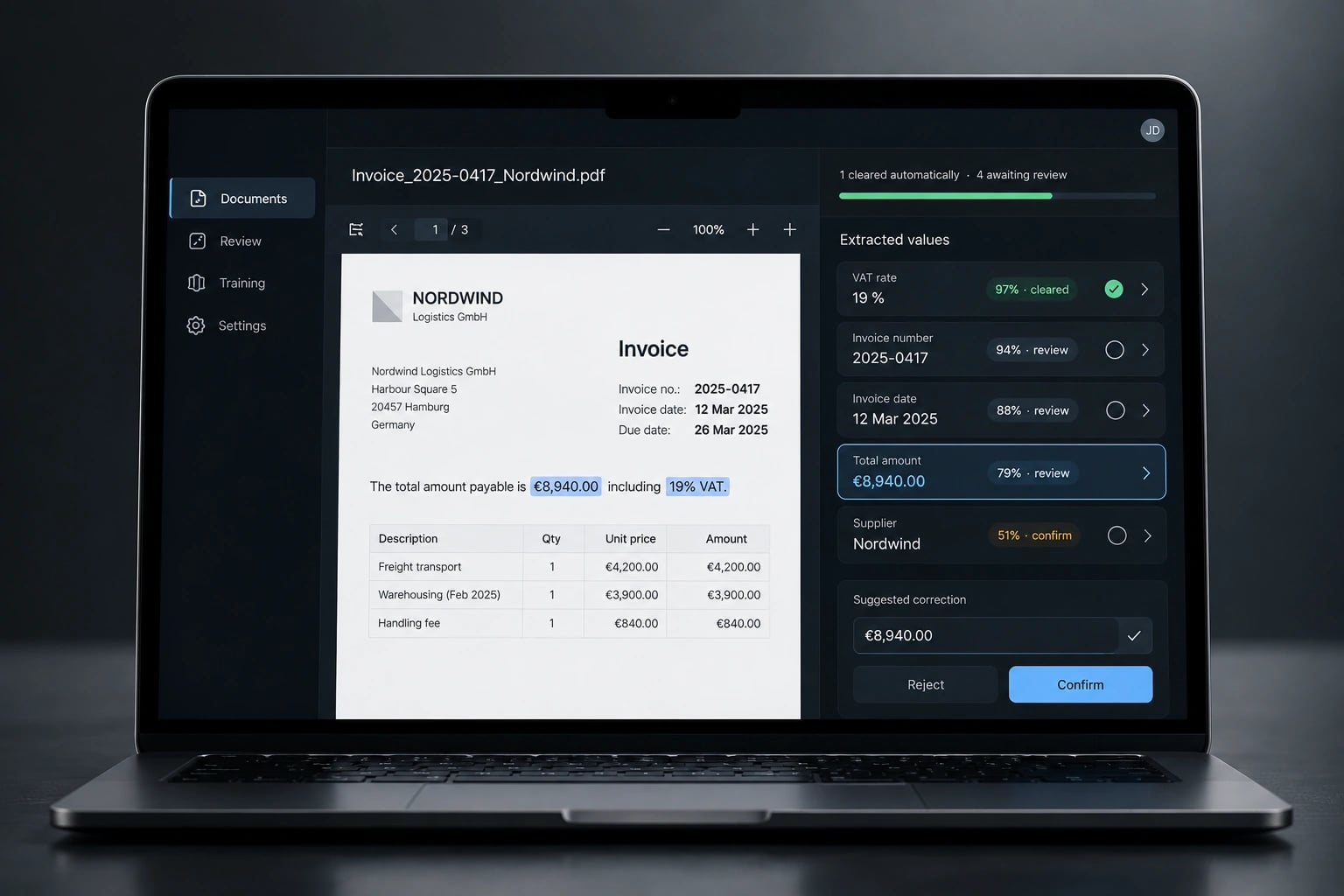
Instead of separating extracted values from their source, the interface keeps both in view. Selecting a value highlights the passage it came from, and selecting a passage opens the value it produced — so reviewers verify instead of hunt. The demo carries all three decisions; try clearing the queue.
Select a value to see its source, confirm the ones awaiting review, and decide what to do with the supplier.
1 cleared automatically · 4 awaiting review
Invoice_2025-0417_Nordwind.pdf
Invoice issued by , Hamburg, for freight and warehousing services rendered in February 2025.
Invoice reference number: .
Invoice date: — payment due within 14 days.
The total amount payable is including VAT.
Extracted values
Cleared automatically — model and document agree.
Evidence highlighted in the document.
Evidence highlighted in the document.
Evidence highlighted in the document.
The document says: “Nordwind Logistics GmbH”
06Decision two
Turn uncertainty into priorities people can act on.
Machine-learning systems express uncertainty as confidence scores. But a percentage on its own doesn’t tell a reviewer what to do. So the interface translates confidence into review priority — surfacing the predictions where human judgment adds the most, and letting the ones the model and document agree on clear with less interaction, within the product’s verification rules.
- 97%✓
Clears quietly
Model and document agree — approved without anyone opening it.
- 79%Review
Worth a glance
Plausible, but not certain — surfaced for a quick look.
- 51%Confirm
Requires confirmation
The model is unsure — exactly where human judgment adds the most.
The aim isn’t to hide uncertainty. It’s to make it understandable and useful: instead of asking someone to interpret a number, the interface says this one deserves your attention.
07Decision three
Make correction part of the normal workflow.
A wrong prediction shouldn’t send anyone into a separate debugging process. Reviewers correct a value in place while its link to the original evidence is preserved, and the correction becomes feedback for future training — without interrupting the flow. Correcting AI should feel like reviewing a document, not like debugging software.
- Cleared automatically19% VAT97% · cleared
- Awaiting review€8,940.0079% · review
- Needs confirmationNordwind51% · confirm
The document says: “Nordwind Logistics GmbH”
Use source valueKeep - CorrectedNordwind Logistics GmbHverified
Corrected from “Nordwind” — fed back to training.
- Record released · audit trail complete
08The experience
A review workflow designed around human judgment.
Together, the decisions connect four elements — and turn AI output into information a person can evaluate and act on.
Prediction
What the system extracted.
Evidence
Where in the document it came from.
Uncertainty
How much attention it needs.
Action
What the reviewer can confirm or correct.
Work through the queue: select a field, inspect the highlighted source, confirm or correct.
09Outcomes
From opaque predictions to verifiable information.
By connecting every prediction to its source, reducing the context switching around it, and making uncertainty actionable, the review workflow became faster and easier to understand — better suited to an enterprise setting where accuracy is a liability question, not a preference. Verification stopped being the slowest part of the workflow.
- Before: Search the document for every value.After: Every value shows its source.
- Before: A confidence score to interpret.After: A priority to act on.
- Before: Corrections as a separate fix.After: Corrections inside the review, fed back to training.
Specific figures are confidential. The review model on this page — evidence, priority, correction — is the part that travels.
10Reflection
Trust is something an interface has to enable.
I used to think trust in AI was a model-quality problem. It isn’t, or not only. People don’t need an AI system to appear certain. They need to know when its output can be relied on, when it needs their attention, and how to step in.
For enterprise AI, transparency isn’t a secondary feature. It is part of the interaction model.